Elbow, Wrist & HandPatient education
Elbow Arthroscopy: Procedure, Benefits, and Recovery
Elbow Arthroscopy Overview What Is Arthroscopy? Arthroscopy is a minimally invasive surgical procedure that allows orthopaedic surgeons to diagnose and treat joint problems. The term "arthroscopy" is derived from the Greek words "arthro" (joint) and "skopein" (to look), meaning…
Published
12 December 2024
Reading time
8 min
Words
1,712
Sections
6
Elbow Arthroscopy Overview
What Is Arthroscopy?
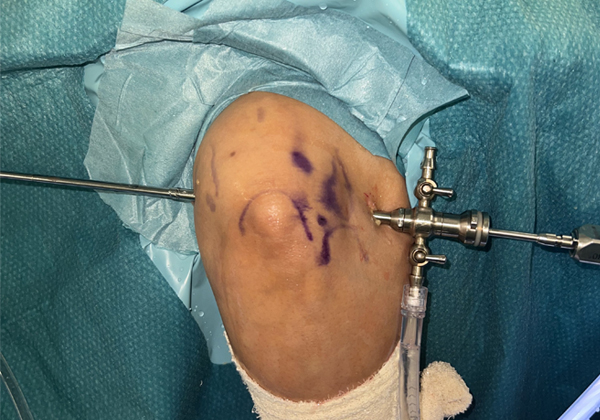
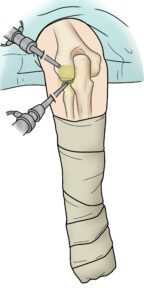
Arthroscopy is a minimally invasive surgical procedure that allows orthopaedic surgeons to diagnose and treat joint problems. The term "arthroscopy" is derived from the Greek words "arthro" (joint) and "skopein" (to look), meaning "to look within the joint." During an elbow arthroscopy:- A small camera called an arthroscope is inserted into the elbow joint.
- The camera projects images onto a monitor, allowing the surgeon to guide thin, specialized surgical instruments.
- Reduced pain.
- Less joint stiffness.
- Faster recovery compared to open surgery.
Elbow Anatomy
The elbow is a complex joint formed by three bones:- Humerus: Upper arm bone.
- Ulna: Forearm bone on the pinky side.
- Radius: Forearm bone on the thumb side.
- Articular Cartilage: Covers the bone surfaces where they meet, providing a smooth, cushioned interface.
- Synovial Membrane: Produces lubricating fluid to minimize friction during movement.
- Collateral Ligaments: Located on the inner and outer sides of the elbow, these ligaments stabilize the joint and prevent dislocation.
- Surrounding Muscles: Facilitate elbow movement and stability.
- Major Nerves: Three nerves cross the elbow joint, requiring careful protection during arthroscopic surgery.
Movements of the Elbow Joint
The elbow enables two primary movements:- Bending and Straightening (Flexion and Extension): Occurs at the joint between the humerus and ulna.
- Forearm Rotation (Pronation and Supination):
- Pronation: Palm facing down.
- Supination: Palm facing up. Rotation occurs at the joint between the ulna and radius and is influenced by muscles and ligaments extending to the wrist.
When Is Elbow Arthroscopy Recommended?
Conditions Treated with Elbow Arthroscopy
Elbow arthroscopy is often recommended for painful conditions that do not respond to nonsurgical treatments such as:- Rest
- Physical therapy
- Medications or injections: These reduce inflammation, which can cause swelling, pain, and stiffness in the elbow.
- Injury
- Overuse
- Inflammatory conditions (e.g., rheumatoid arthritis)
- Age-related wear and tear
Common Uses of Elbow Arthroscopy
Elbow arthroscopy can address various conditions that damage cartilage and soft tissues in the joint. It may be recommended to:- Treat Tennis Elbow (Lateral Epicondylitis): Relieves pain and restores function.
- Remove Loose Bodies: Removes loose cartilage or bone fragments causing discomfort.
- Release Scar Tissue and Bone Spurs: Improves range of motion by removing obstructions.
- Treat Osteoarthritis: Eases symptoms of wear-and-tear arthritis.
- Treat Rheumatoid Arthritis: Reduces inflammation and pain caused by this autoimmune condition.
- Address Osteochondritis Dissecans: Repairs damage to the humerus (capitellum) seen in activities like throwing or gymnastics.
- Treat Some Fractures: Helps manage certain types of elbow fractures.
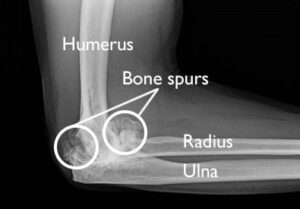
This X-ray of an elbow taken from the side shows severe osteoarthritis. Note the large bone spurs that have formed around the joint. During an arthroscopic procedure, these bone spurs can be removed, along with any loose fragments of cartilage.
Keep reading