The Importance of Ergonomics in Preventing Arm Injuries at Work
Implementing ergonomic principles helps reduce the risk of repetitive strain injuries (RSIs), musculoskeletal disorders (MSDs), and other conditions that can result from poor workplace design and practices.

Ergonomics for Arm Health
A practical guide to protecting your shoulders, elbows, wrists and hands at work, at home and in sport.
Why Ergonomics Matters for Your Arms
Your upper limbs are designed for movement, not for sustained fixed postures. Most modern arm complaints build gradually from how we sit, type, lift, sleep, train and use our phones every day.
Good ergonomics means fitting the task to your body rather than forcing your body to fit the task. When the fit is right, tendons glide freely, joints stay centred, nerves are not compressed, and muscles share the load. When the fit is wrong, small daily strains can accumulate into tendinopathy, nerve entrapment, joint pain and structural damage.
A Quick Tour of the Upper Limb
Understanding what is under load helps you protect it. Your arm is a chain: what happens at the neck and shoulder blade affects the wrist, and vice versa.
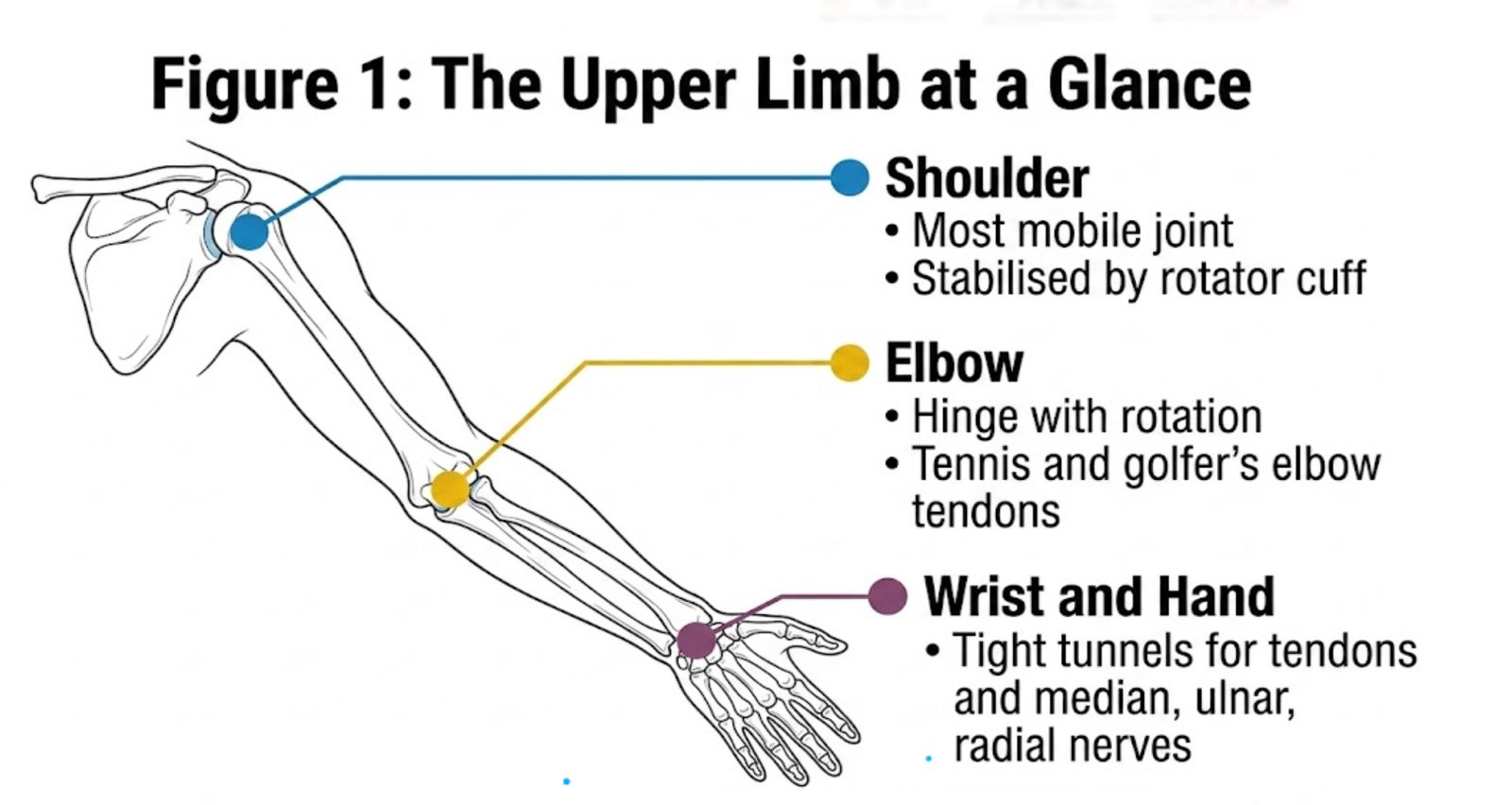
The shoulder
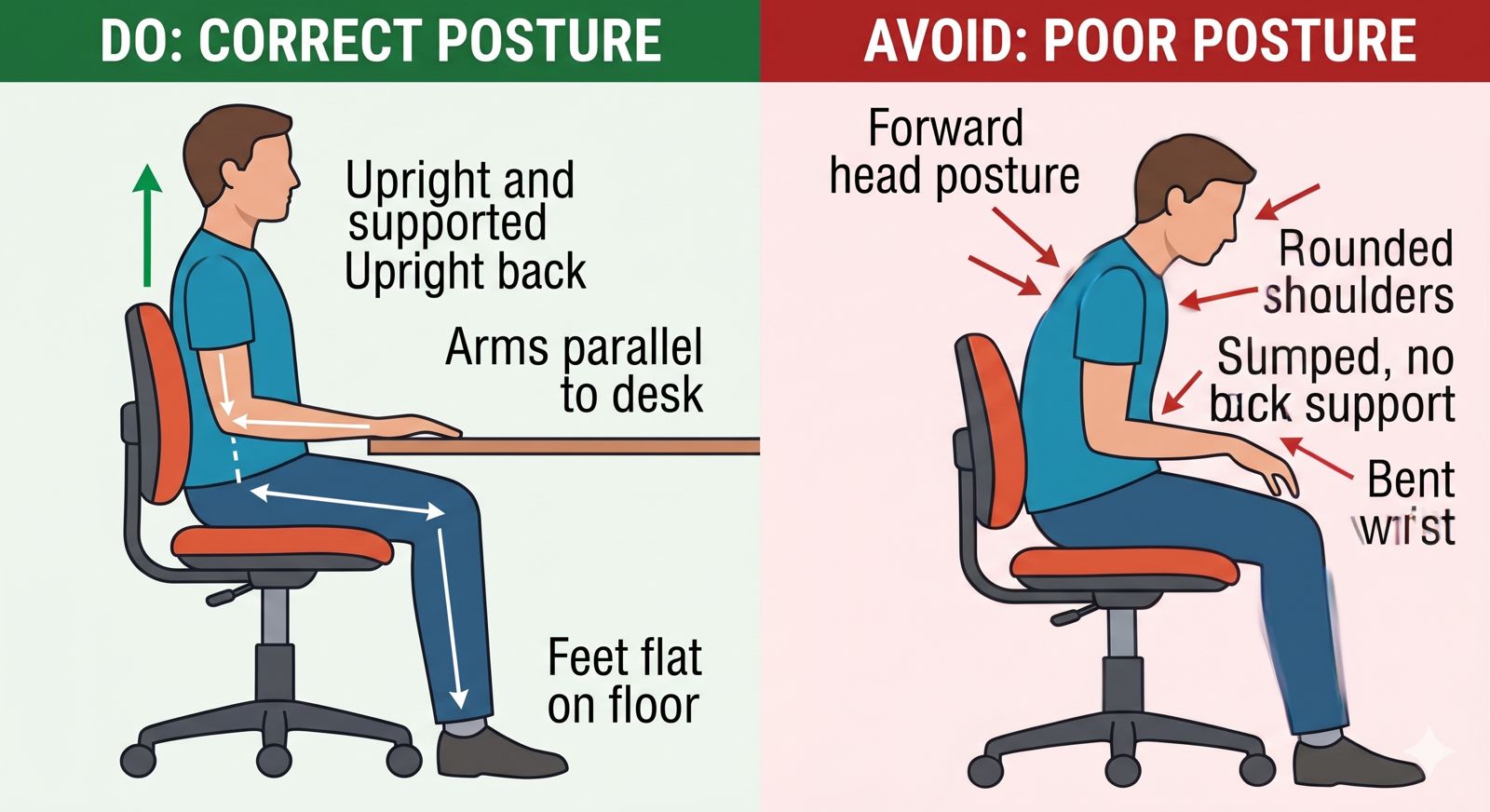
The shoulder is the most mobile joint in the body. Stability comes mainly from the rotator cuff and the shoulder blade. Slumped posture tilts the scapula forward, narrowing the space the rotator cuff tendons travel through.
The elbow
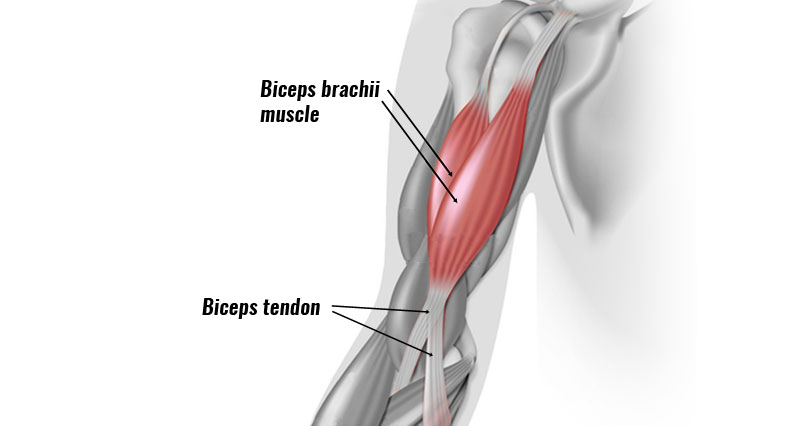
The elbow is a hinge with rotation. Tendons that bend the wrist and fingers anchor on the inside, while tendons that extend the wrist anchor on the outside. Repetitive gripping, twisting and forceful mouse use overload these anchors.
The wrist and hand
Tendons run through tight tunnels at the wrist alongside the median, ulnar and radial nerves. Sustained wrist bending, especially extension while typing or flexion while sleeping, can compress these structures and aggravate carpal tunnel syndrome, De Quervain’s tenosynovitis and cubital tunnel syndrome.
Early Warning Signs You Should Not Ignore
- Aching in the shoulder, forearm or hand at the end of the working day.
- Numbness, tingling or pins and needles in the fingers, especially at night or on waking.
- Weak or clumsy grip, such as dropping cups or struggling with jars and keys.
- Pain that flares with using a mouse, lifting a kettle or reaching to a high shelf.
- Morning stiffness that takes more than a few minutes to ease.
- Clicking, catching or locking in the shoulder or thumb.
- Persistent neck or upper-back tightness with arm symptoms.
Setting Up Your Desk and Workstation
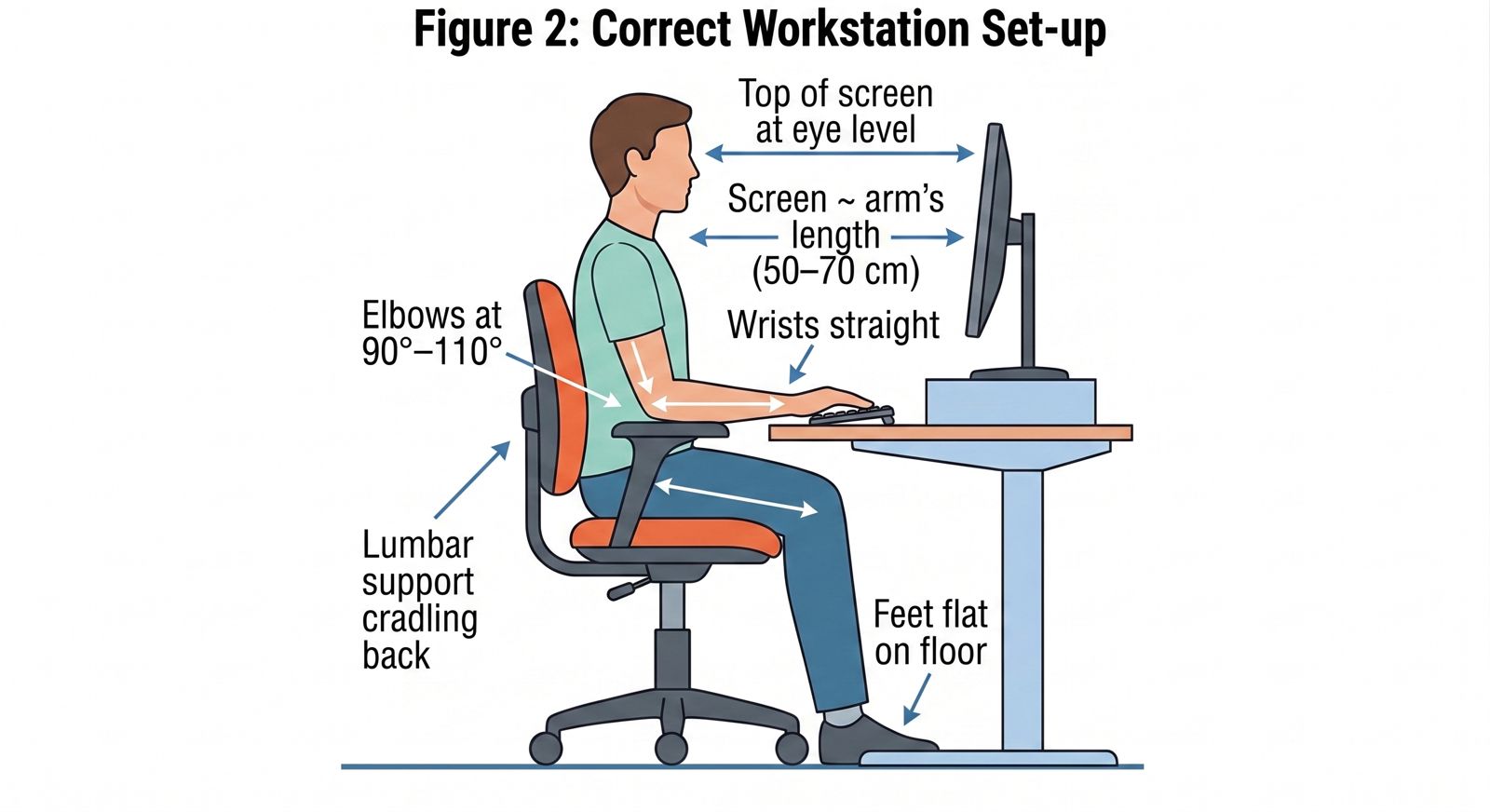
The desk is where many upper-limb overuse injuries are made. Aim for a posture that is neutral, supported and varied.
The foundation: chair, feet and pelvis
- Sit fully back in the chair with lumbar support cradling the small of your back.
- Set seat height so your feet rest flat on the floor or a footrest, with thighs roughly parallel to the floor.
- Keep hips very slightly higher than knees to reduce slumping.
- Leave a two-finger gap between the back of your knees and the seat edge.
- Armrests should support the elbows so the shoulders relax.
Screen position — the single biggest lever
- Top of the screen at or just below eye level when sitting tall.
- Screen approximately an arm’s length away, around 50-70 cm.
- Tilt the screen slightly back, around 10-20 degrees.
- Raise laptops on a stand and use a separate keyboard and mouse.
- If using two monitors, place the primary monitor directly in front of you.
Keyboard and mouse
| Joint | Target position | Common error to avoid |
|---|---|---|
| Shoulder | Relaxed, not shrugged; upper arm vertical. | Hunching up to reach a high desk. |
| Elbow | Bent 90-110 degrees, close to the body. | Reaching forward or out to the side. |
| Forearm | Parallel to the floor or sloping slightly down. | Forearms angled up to a high keyboard. |
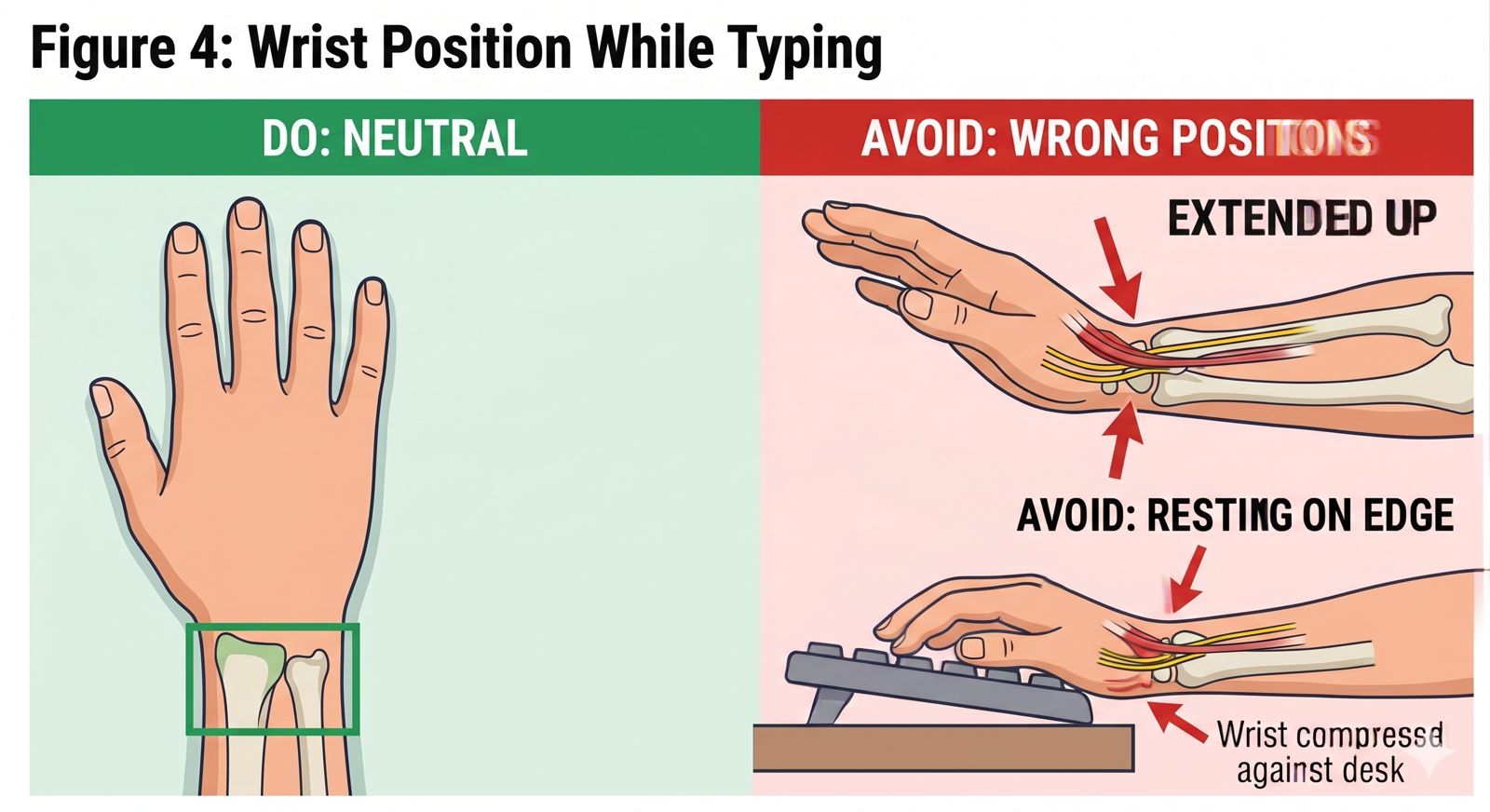
| Wrist | Straight, not bent up, down or sideways. | Resting on the desk edge while typing. |
| Hand | Fingers curved naturally over the keys. | Flat-handed pounding or stretching for keys. |
Do
- Keep the mouse next to the keyboard at the same height.
- Move the mouse from the shoulder, not the wrist.
- Use a vertical or contoured mouse if you have wrist pain.
- Use keyboard shortcuts to reduce mouse use.
- Consider a split or tented keyboard for chronic forearm pain.
- Take micro-pauses every 20-30 minutes.
Avoid
- Resting wrists hard on the desk edge while typing.
- Pinching a small mouse with cramped fingers.
- Stretching far to reach a number pad.
- Using a laptop trackpad for long sessions.
- Typing with long, unsupported fingernails.
- Working through pain.
Sleeping Postures and Your Arms
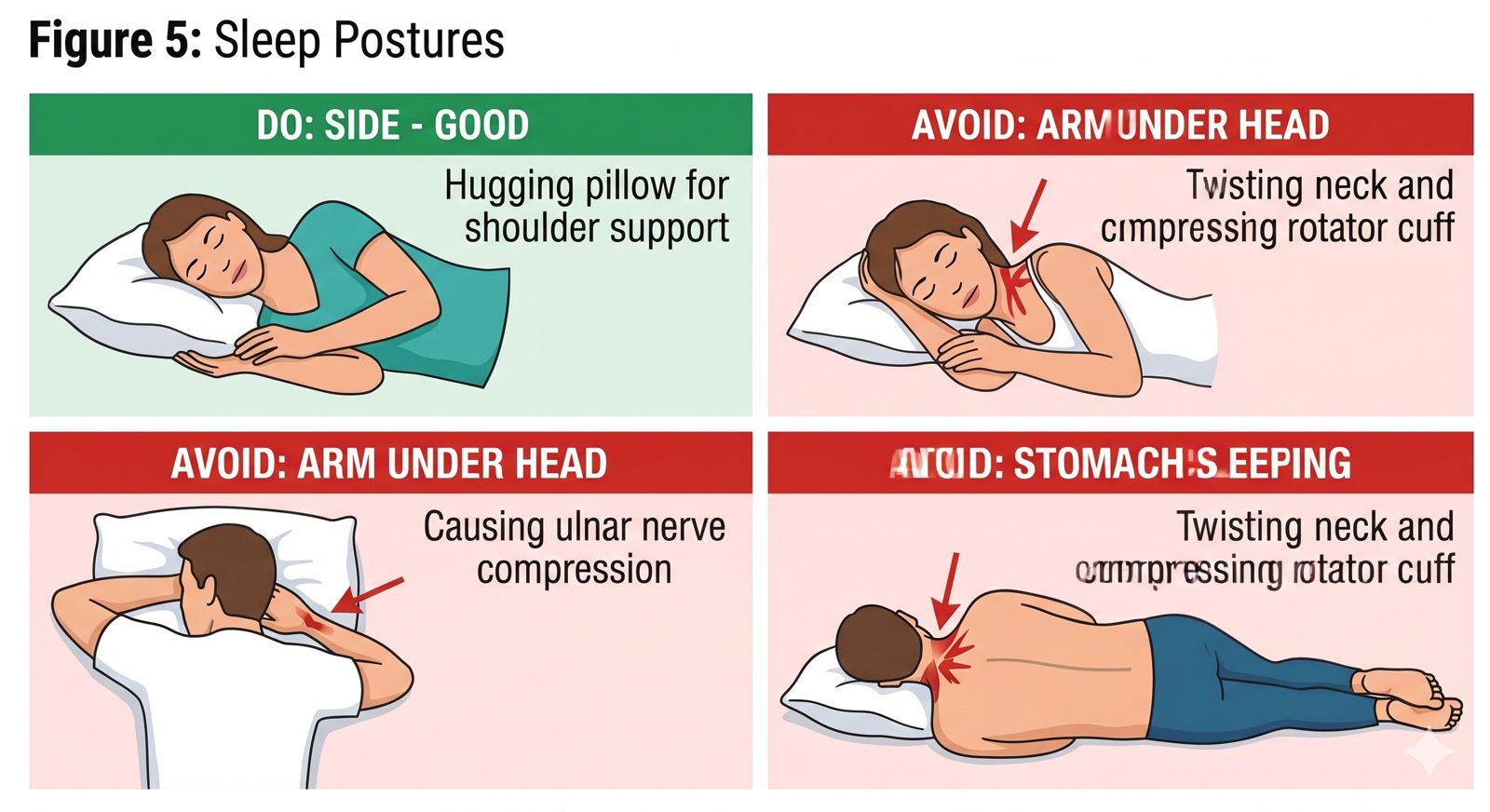
Sleep is when tissues recover, but only if you are not loading them for seven hours. Frozen shoulder, rotator cuff pain, carpal tunnel symptoms and cubital tunnel syndrome are all influenced by sleep posture.
Side sleepers
- Avoid sleeping directly on the painful shoulder.
- Hug a pillow to stop the top shoulder rolling forward.
- Keep elbows softly bent, not tightly flexed under the chin.
- Keep wrists straight; a soft wrist splint may help night symptoms.
Back sleepers
- Place a small pillow under each forearm.
- Avoid sleeping with arms above the head.
Stomach sleepers
- Try to transition to side or back sleeping.
- If you cannot change, keep arms by the sides rather than overhead.
Phones, Tablets and Handheld Devices
Phone use
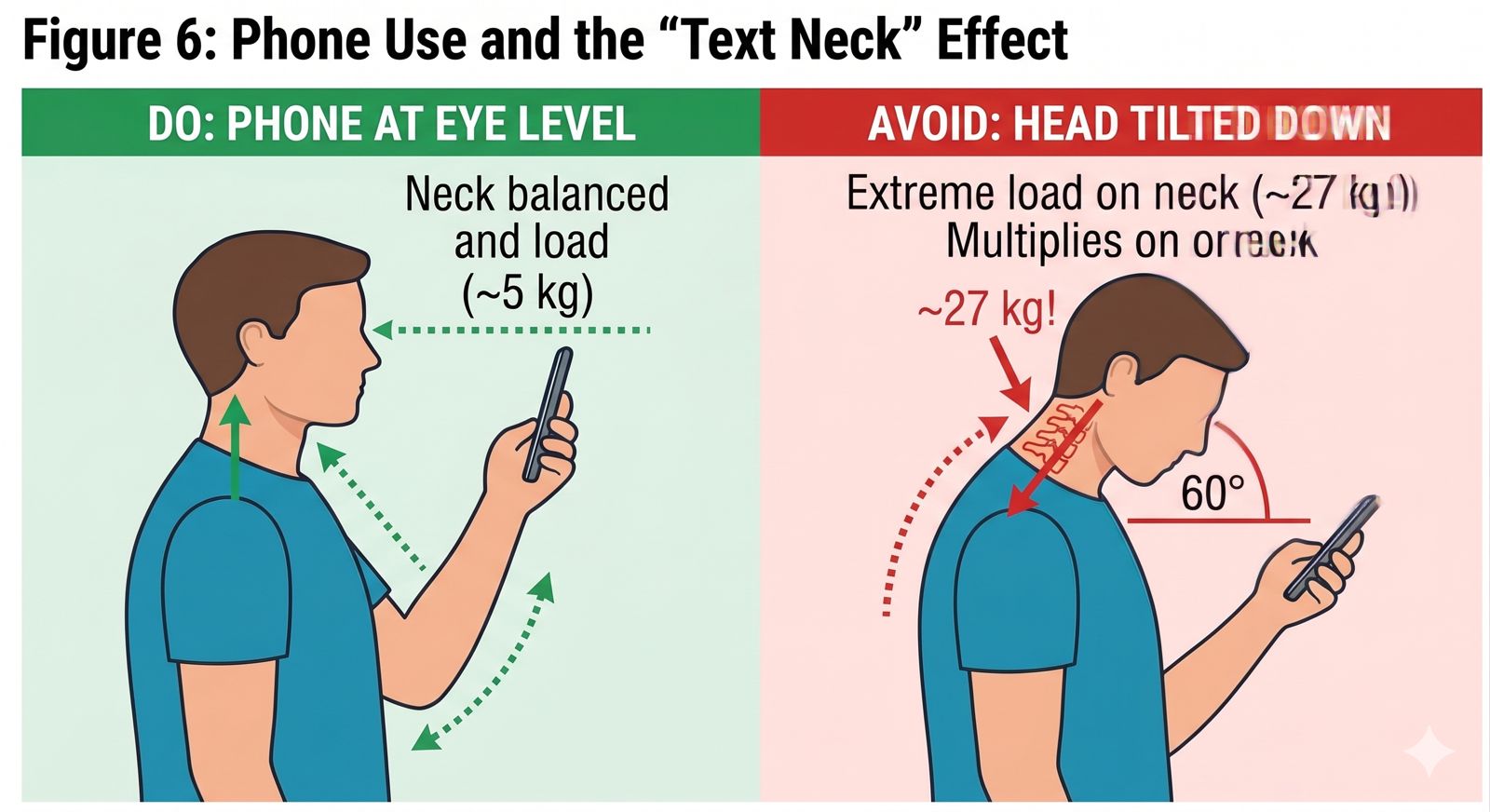
- Bring the phone up to eye level.
- Use both hands and alternate thumbs.
- Use voice dictation for longer messages.
- When reading in bed, prop the phone against a stand or pillow.
Tablets, e-readers and gaming
- Use a stand or case rather than laying tablets flat.
- Pair a Bluetooth keyboard for sessions over 15 minutes.
- Avoid prolonged single-finger scrolling.
- Bring controllers close to the body and take movement breaks every 45 minutes.
Driving Ergonomics
- Sit with your back fully into the seat and lumbar support filling the curve.
- Set the seat distance so knees stay slightly bent when pedals are fully depressed.
- Adjust the backrest so shoulders touch it and wrists rest comfortably on top of the wheel.
- Hold the wheel at 9 and 3 rather than 10 and 2.
- Relax the grip; avoid white-knuckling the wheel.
- Stop every 90-120 minutes on long journeys to walk and shake out the arms.
- Avoid resting the elbow on the door frame.
Lifting, Carrying and Daily Tasks
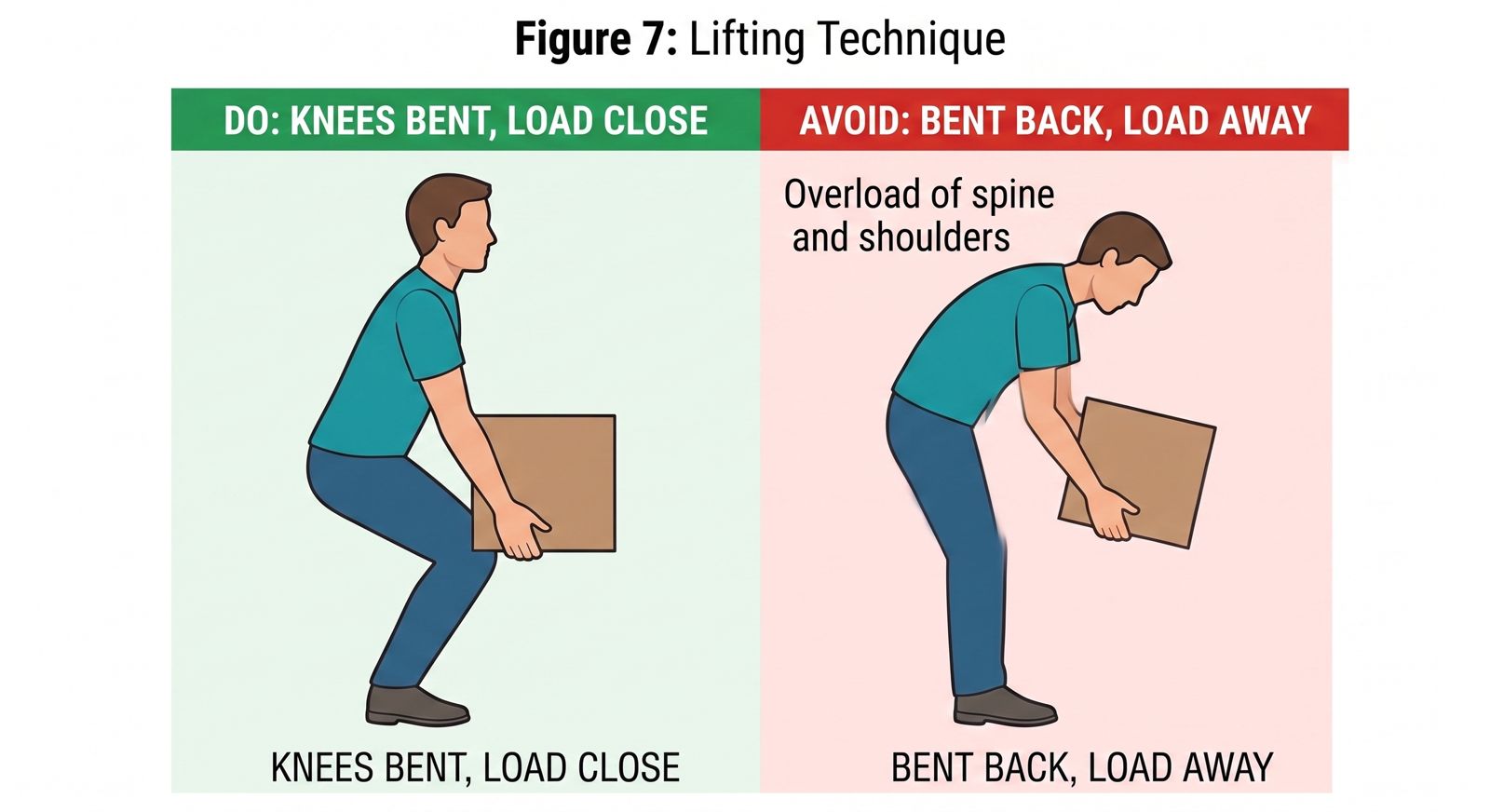
Lifting principles
- Keep the load close to your body.
- Bend the knees and hinge at the hips.
- Test the weight before committing.
- Do not twist while lifting; move your feet to turn.
- Use two smaller trips rather than one heavy one.
- Avoid lifting overhead in one motion.
Carrying loads
- Distribute weight between both hands.
- Use a backpack with both straps for loads over 4-5 kg.
- Avoid hooking shopping bags on one bent finger.
- Use wheeled trolleys for shopping, luggage and laundry.
Kitchen and home
- Raise low chopping surfaces with a thick board.
- Use sharp knives and pans with two handles.
- Use jar openers rather than repeated forceful gripping.
- Swap hands when vacuuming or mopping.
- For gardening, kneel, use long-handled tools and wear padded gloves.
Parenting and childcare
- Lift children close to the body with both hands under the trunk.
- Use slings or carriers and alternate hip-carry sides.
- Use pillows or a feeding cushion to bring the baby to you.
- Adjust pram handles to hip-to-waist height.
- Watch for thumb-side wrist pain when lifting a baby.
Sport, Training and the Gym
Exercise is medicine for the upper limb when programmed sensibly. Most sports-related arm injuries are caused by training error: too much, too soon, with too little recovery.
- Warm up specifically for the activity.
- Progress load by no more than 10% per week.
- Balance pushing and pulling exercises.
- Train the rotator cuff and scapular muscles directly.
- Prioritise sleep, hydration and protein intake for tendon recovery.
| Exercise | Risk | Better technique |
|---|---|---|
| Bench press | Shoulder impingement | Tuck elbows around 45 degrees, retract scapulae and use controlled range. |
| Lat pulldown / pull-up | Shoulder pinching | Pull to upper chest, not behind the neck. |
| Upright row | Rotator cuff impingement | Limit elbow height to shoulder level or replace with face pulls. |
| Dips | Anterior shoulder pain | Avoid if painful; keep depth shallow. |
| Heavy biceps curls | Distal biceps and elbow strain | Control the lowering phase and avoid swinging. |
| Press-ups | Wrist pain | Use push-up handles or fists; keep elbows close. |
Racquet and overhead sports
- Check grip size, string tension and stroke mechanics.
- A grip that is too small forces squeezing; too large overloads the forearm extensors.
- Throwing athletes should use structured throw counts and never throw through shoulder pain.
Climbing and calisthenics
- Progress tendon-loading volume gradually.
- Add antagonist training such as push-ups and finger-extension bands.
- Respect mild finger discomfort before pulley injuries develop.
Microbreaks and Movement Snacks
The most powerful habit after improving the workstation is brief, frequent movement. This routine takes under two minutes and addresses common trouble spots.
| Movement | How | Reps |
|---|---|---|
| Chin tucks | Sit tall. Glide chin straight back, eyes level. Hold 3 seconds. | 10 |
| Shoulder rolls | Roll shoulders up, back and down. | 10 |
| Doorway pec stretch | Forearm on door frame, step through. | 2 each side |
| Wrist flexor stretch | Arm out, palm up, gently pull fingers down. | 2 each side |
| Wrist extensor stretch | Arm out, palm down, gently pull fingers down. | 2 each side |
| Median nerve glide | Arm out, palm up; tilt head away as you gently bend the wrist back. | 5 each side |
| Scapular squeezes | Pinch shoulder blades down and back, not up. | 10 |
Self-Care for Early Symptoms
Relative rest, not complete rest
Reduce the aggravating activity, but keep the limb moving. Complete immobilisation stiffens joints and weakens muscles.
Ice and heat
Ice helps acute, swollen, painful flares. Heat helps stiffness and chronic aches.
Splints and supports
A wrist splint at night for carpal tunnel, elbow strap for tennis elbow or thumb spica for De Quervain’s can help, alongside activity change.
Loaded tendon rehabilitation
Tendinopathy responds to gradual loading, not rest. A physiotherapist can guide a progressive programme.
Special Considerations
Working from home
A dining-table setup with a laptop stand, separate keyboard and lumbar cushion is far better than sofa working. Define a workspace and pack it away at the end of the day.
Pregnancy and postnatal
Hormonal changes can increase carpal tunnel risk. Night splints are often effective, and feeding posture matters.
Older adults
Maintaining shoulder range of motion helps protect against falls-related upper-limb fracture. Resistance training preserves bone density and grip strength.
Manual workers and performers
Use anti-vibration gloves, rotate tasks, choose tools carefully and practise or work in shorter blocks rather than long sessions.
Frequently Asked Questions
Is it really my desk that is causing my shoulder pain?
In many cases, yes, at least in part. A correct workstation may not cure every shoulder problem, but shoulder problems in desk workers rarely improve while the workstation remains badly set up.
Should I use a wrist rest?
Wrist rests are for resting between bursts of typing, not during typing. Float the hands while typing and rest them when pausing.
Are vertical mice worth it?
For established forearm or wrist pain, they can help by putting the forearm in a more neutral handshake position. They work best alongside a good overall setup.
How long should I wear a wrist splint at night?
Most patients with carpal tunnel symptoms benefit from nightly use for 4-6 weeks alongside daytime ergonomic changes. Persistent symptoms warrant specialist review.
Is cracking my knuckles harmful?
Knuckle cracking has not been shown to cause arthritis. If it is uncomfortable, stop; if it is simply a habit, it is usually not harmful.
My pain is worse at night. Is that significant?
Yes. Night pain that disrupts sleep, or pain that wakes you, can point to rotator cuff disease, frozen shoulder or nerve compression and warrants assessment.
Should I push through pain when exercising?
Sharp pain should not be pushed through. A dull ache up to about 4/10 during tendon rehabilitation may be acceptable if it settles within 24 hours.
Can poor posture cause permanent damage?
Posture itself rarely causes structural damage, but repetitive overload sustained over time can drive tendinopathy, nerve compression and arthritis. Correct it early.
A Final Word
Most upper-limb problems are not caused by what you did once; they are caused by what you do every day. Small, consistent changes to how you sit, move, sleep and train can protect your arms for decades.
Professor Mohamed A. Imam
Consultant Orthopaedic Surgeon — Upper Limb, Sports Injuries & Complex Trauma
MD, MSc(Hons), PhD, FRCS (Tr & Orth)
This patient information page is provided for educational purposes and does not replace individual medical advice. If you have specific concerns or persistent symptoms, please seek assessment from a qualified healthcare professional.