KneePatient education
Osteoarthritis of the Elbow
Osteoarthritis usually affects the weight-bearing joints, such as the hip and knee
Published
17 September 2024
Reading time
4 min
Words
984
Sections
5
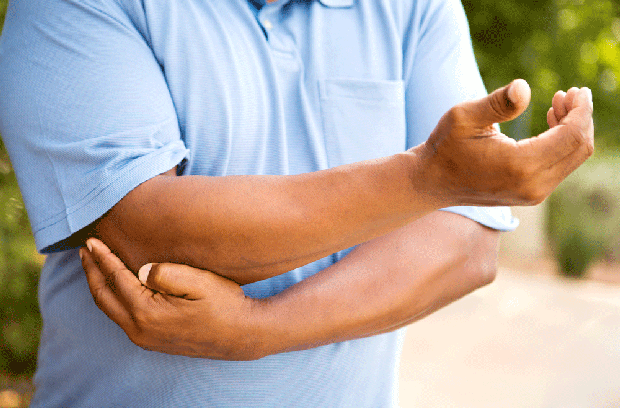
Osteoarthritis of the elbow occurs when the cartilage surface of the elbow is worn out or is damaged. This can happen because of a previous injury such as elbow dislocation or fracture.
Most commonly, however, it results from a regular wearing away of the joint cartilage from age and activity.
Osteoarthritis usually affects the weight-bearing joints, such as the hip and knee. The elbow is one of the least affected joints because of its well-matched joint surfaces and strong stabilizing ligaments.
As a result, the elbow joint can tolerate large forces across it without becoming unstable.
Cause
Some patients diagnosed with elbow osteoarthritis have a history of injury to the elbow, such as a fracture that involved the joint's surface or an elbow dislocation.
The risk for elbow arthritis increases if:
? The patient needed surgery to repair the injury or reconstruct the joint
? There is loss of joint cartilage
? The joint surface cannot be repaired or rebuilt to its preinjury level
Injury to the ligaments resulting in an unstable elbow can also lead to osteoarthritis, even if the elbow surface is not damaged, because the normal forces across the elbow are altered, causing the joint to wear out more rapidly.
In some patients, no single injury to the elbow occurs. Work or outside activities can lead to osteoarthritis of the elbow if the patient places more demands on the joint than it can bear. For example, professional baseball pitchers place unusually high demands on their throwing elbows, which can lead to failure of the stabilizing ligaments. When this occurs, surgical reconstruction may be needed. High-shear forces placed across the joint can lead to cartilage breakdown over the years.
The best way to prevent elbow arthritis is to avoid injury to the joint. When damage does occur, it is essential to recognize it right away and get treatment. Individuals involved in heavy work or sports activities should maintain muscular strength around the elbow. Proper conditioning and technique should always be used.
Symptoms
The most common symptoms of elbow arthritis are:
? Pain
? Loss of range of motion
Both of these symptoms may not occur at the same time. Patients usually report a 'grating' or 'locking' sensation in the elbow. The 'grating' is due to the loss of the normal smooth joint surface. This is caused by cartilage damage or wear.
The 'locking' is caused by loose pieces of cartilage or bone that dislodge from the joint and become trapped between the moving joint surfaces, blocking motion.
In the later stages of osteoarthritis of the elbow, patients may notice numbness in their ring finger and small finger. This can be caused by elbow swelling or a limited range of motion in the joint. The 'funny bone' (ulnar nerve) is located in a tight tunnel behind the inner (medial) side of the elbow. Swelling in the elbow joint can put increased pressure on the nerve, causing tingling. If the elbow cannot be moved through its normal range of motion, it may stiffen into a position where it is bent (flexion). This can also cause pressure around the nerve to increase.
Doctor Examination
A doctor can usually diagnose osteoarthritis of the elbow based on symptoms and standard x-rays. X-rays show arthritic changes. Advanced diagnostic imaging, such as CT (computed tomography) or MRI (magnetic resonance imaging), is typically not needed to diagnose osteoarthritis of the elbow.
Elbow osteoarthritis that occurs without previous injury is more common in men than women. Onset typically occurs in patients 50 years of age or older, but some patients can have symptoms earlier.
Treatment
Treatment options depend on the stage of the disease, prior history, what the patient desires, overall medical condition, and the results of x-rays and other tests.