Ankle & FootPatient education
Bunions
The big toe i�up of two jointss made
Published
22 May 2024
Reading time
8 min
Words
1,887
Sections
1
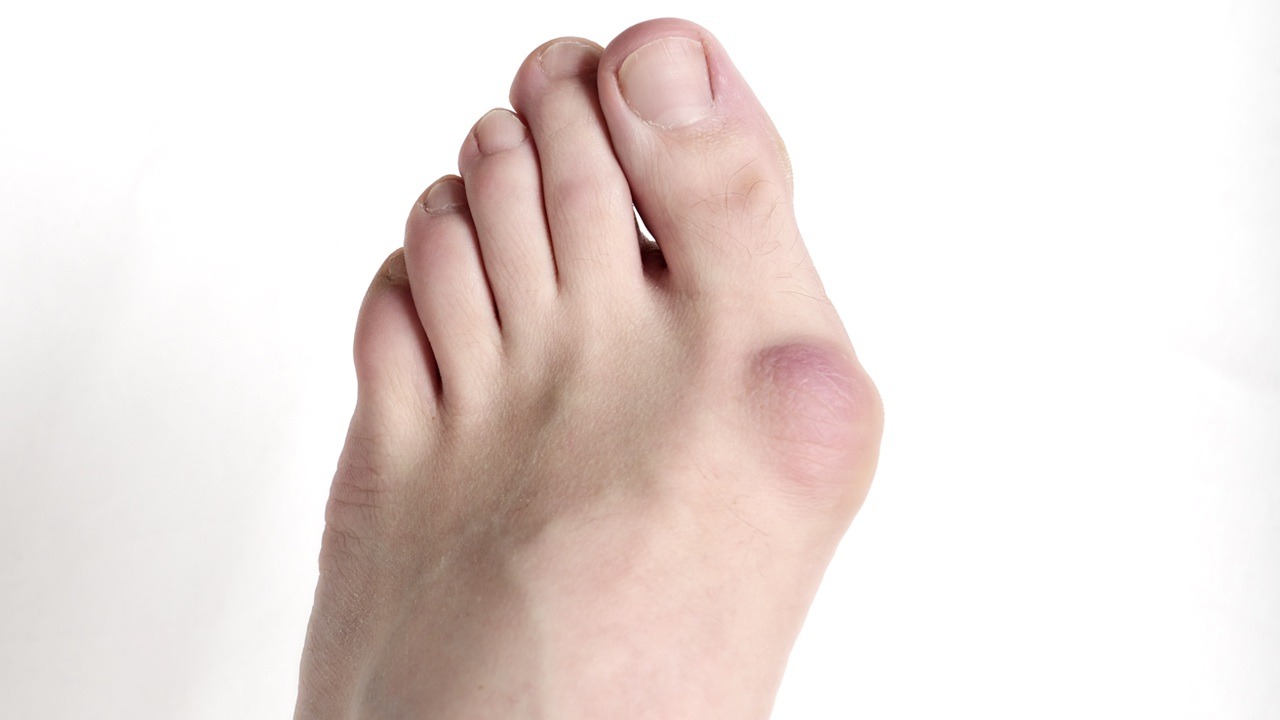
A bunion is a painful bony bump that develops on the inside of the foot at the big toe joint. Bunions are associated with hallux valgus, a condition where the big toe drifts toward the smaller toes and the outside of the foot.Pain from bunions develops over the bony bump due to shoe irritation, and in the other toes due to crowding and altered mechanical forces in the ball of the foot.Bunions usually develop slowly. Pressure on the big toe joint causes the big toe to lean toward the second toe. Over time, the normal position of the bone, tendons, and ligaments changes, resulting in the bunion deformity. Often, this deformity gradually worsens over time and may make it painful to wear shoes or walk.
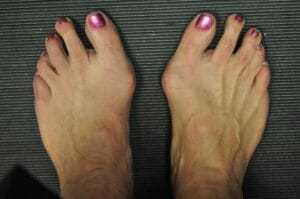
Anatomy
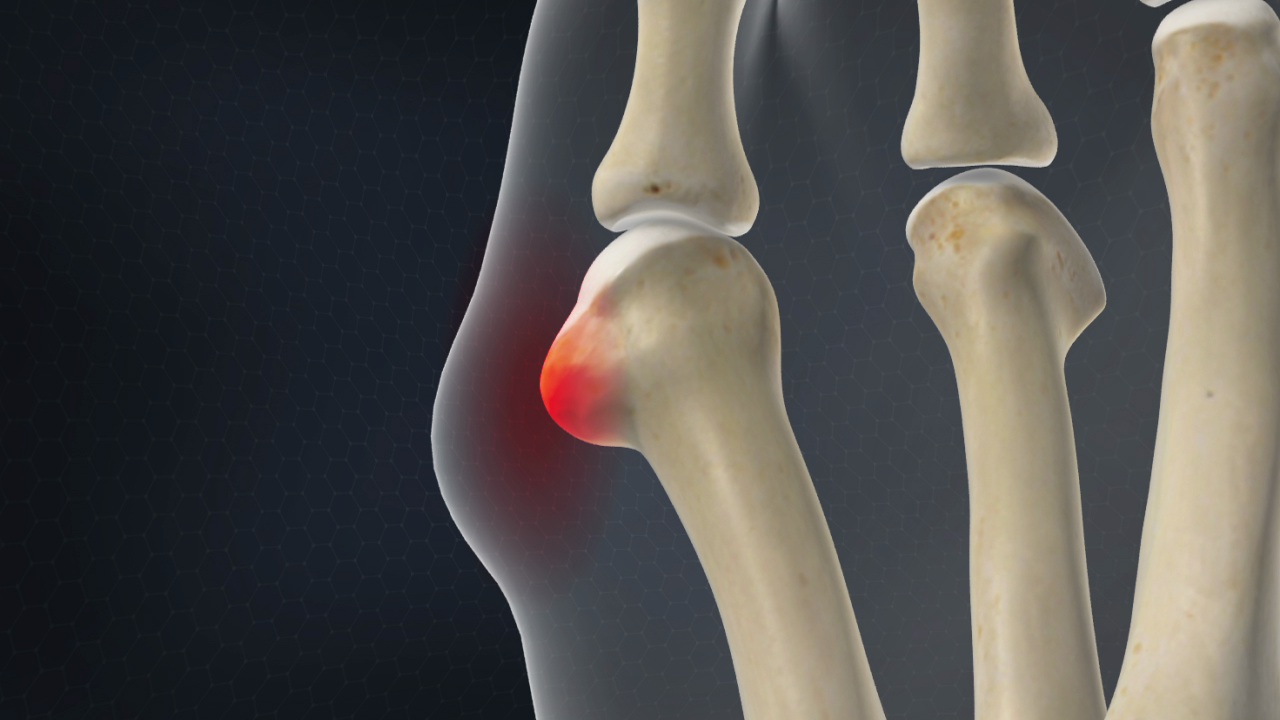
The big toe i'up of two jointss made. The largest of the two is the metatarsophalangeal joint (MTP), where the first long bone of the foot (metatarsal) meets the first bone of the toe (phalanx).
Bunions develop at the MTP joint.
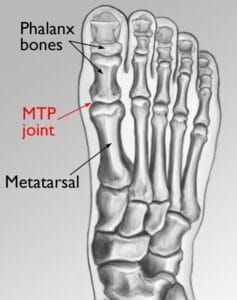
The bones of the foot and the metatarsophalangeal (MTP) joint.
Description
A bunion forms when the bones that make up the MTP joint move out of alignment: The long metatarsal bone shifts toward the inside of the foot, and the phalanx bones of the big toe angle toward the second toe. The MTP joint gets larger and protrudes from the inside of the forefoot.
The enlarged joint is often inflamed due to abnormal mechanics and direct irritation. The word "bunion" comes from the Greek word for turnip, and the bump on the inside of the foot typically looks red and swollen like a turnip
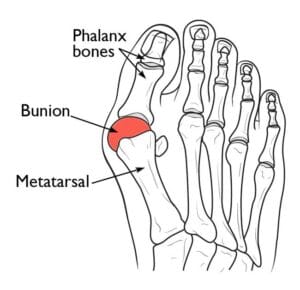
The MTP joint becomes enlarged and inflamed
Bunion Progression
Bunions start out small, but they often get worse over time. Because the MTP joint flexes with every step, the bigger the bunion gets, the more painful and difficult walking can become. An advanced bunion can greatly alter the appearance of the foot. In severe bunions, the big toe may angle all the way under or over the second toe. Pressure from the big toe may force the second toe out of alignment, causing it to come in contact with the third toe. This can result in'hammer toe deformities'of the smaller toes. Calluses may also develop where the toes rub against each other, causing additional discomfort and difficulty walking.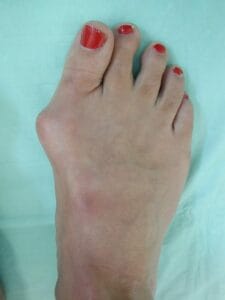
Bunions often worsen over time. As the big toe angles toward the second toe, it can cross over it and cause additional problems.
Foot Problems Related to Bunions
In some cases, an enlarged MTP joint may lead to bursitis, a painful condition in which the fluid-filled sac (bursa) that cushions the bone near the joint becomes inflamed. It may also lead to chronic pain and'arthritis'if the smooth articular cartilage that covers the joint becomes damaged from the joint not gliding smoothly.Adolescent Bunion
In addition to the common bunion, there are other types of bunions. As the name implies, bunions that occur in young people are called adolescent bunions. These bunions are most common in girls between the ages of 10 and 15. While a bunion on an adult often restricts motion in the MTP joint, a young person with a bunion can normally move the big toe up and down. An adolescent bunion may still be painful, however, and make it difficult to wear shoes.Bunionette
A bunionette, or "tailor's bunion," occurs on the outside of the foot near the base of the little toe. Although it is in a different spot on the foot, a bunionette is very much like a bunion. You may develop painful bursitis and a hard corn or callus over the bump.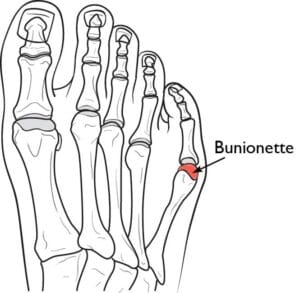
A bunion that forms in the main joint of the little toe is called a bunionette
Cause
Bunions may be caused by:
- Wearing poorly fitting shoes ' in particular, shoes with a narrow, pointed toe box that forces the toes into an unnatural position. Learn more:'Tight Shoes and Foot Problems
- Heredity ' some people inherit feet that are more likely to develop bunions due to their shape and structure.
- Having an inflammatory condition, such as'rheumatoid arthritis, or a neuromuscular condition, such as'Charcot-Marie-Tooth disease'or polio.
Symptoms
In addition to the visible bump on the inside of the foot, symptoms of a bunion may include:
- Pain and tenderness
- Redness and inflammation
- Hardened skin on the bottom of the foot
- A callus or'corn'on the bump
- Stiffness and restricted motion in the big toe, which may lead to difficulty walking
Doctor Examination
Physical Examination
Your doctor will ask you about your medical history, general health, and symptoms. They will perform a careful examination of your foot. Although your doctor will probably be able to diagnose your bunion based on your symptoms and the appearance of your toe, they will also order an X-ray.X-Rays
X-rays provide images of dense structures, such as bone. An X-ray will allow your doctor to:
- Check the alignment of your toes and look for damage to the MTP joint. The alignment of your foot bones changes when you stand or sit. Your doctor will take an X-ray while you are standing to more clearly see the malalignment of your foot bones.
- Determine whether there is arthritis associated with the bunion.
- Determine how severe the bunion is, and how best to correct it.
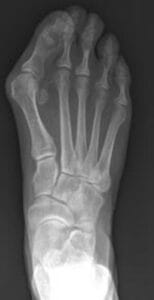
X-rays of your foot will show your doctor how far out of alignment the bones have become.Reproduced from Wagner E, Ortiz C: Proximal Oblique Sliding Closing-wedge Osteotomy for Wide-angle Hallux Valgus. Orthopaedic Knowledge Online Journal: Vol 12, No 4, 4/1/2014; Accessed December 4, 2015.
Nonsurgical Treatment
In most cases, bunions are treatable without surgery. Bunions that are not painful can be observed without any treatment at all. Although nonsurgical treatment cannot actually reverse a bunion, it can help reduce pain and keep the bunion from worsening.
Changes in Footwear
Pain from bunion pain can often be managed successfully by switching to shoes that fit properly, with a wide or open toe box that does not compress the toes. Some shoes can be modified by using a stretcher to stretch out the areas that put pressure on your toes. Your doctor can give you information about proper shoe fit and the type of shoes that would be best for you. (See "Tips for Proper Shoe Fit" below)Padding
Protective silicone pads, worn inside of your shoe, can help cushion the painful area over the bunion. Pads can be purchased at a drugstore or pharmacy. Be sure to test the pads for a short time period first. The size of the pad may increase the pressure on the bump, and this could worsen your pain rather than reduce it.Orthotics and Other Devices
To take pressure off your bunion, your doctor may recommend:- Over-the-counter or custom-made shoe inserts (orthotics).
- Toe spacers, which are placed between your toes.
- In some cases, a splint worn at night that places your big toe in a straighter position, which may help relieve pain. Braces or splints have not, however, been shown to permanently fix bunion
Medications
Nonsteroidal anti-inflammatory drugs (NSAIDs)'such as ibuprofen and naproxen can help relieve pain and reduce swelling. Other medications can be prescribed to help pain and swelling in patients whose bunions are caused by arthritis.Tips for Proper Shoe Fit
If you have bunions, it is important that your shoes fit correctly. In general:
- Choose shoes with wide insteps, broad toe boxes, soft soles, and plenty of stability.
- Avoid shoes that are too short, tight, or sharply pointed, and those with heels higher than a couple of inches. Higher-heeled shoes put more pressure on the forefoot and increase the likelihood of foot problems or injury.
- If you have pain with motion on the MTP joint, a shoe with a slight rocker bottom will be helpful.
The following tips will help you choose a shoe that fits correctly:
- Do not select shoes by the size marked inside the shoe. Sizes vary among shoe brands and styles. Judge the shoe by how it fits on your foot.
- Select a shoe that conforms as closely as possible to the shape of your foot.
- Have your feet measured regularly. The size of your feet changes as you grow older.
- Have both feet measured. In most people, one foot is larger than the other. Fit shoes to the largest foot.
- Fit at the end of the day when your feet are the largest.
- Stand during the fitting process and check that there is adequate space (3/8" to 1/2") for your longest toe at the end of the shoe.
- Make sure the ball of your foot fits well into the widest part (ball pocket) of the shoe.
- Do not purchase shoes that feel too tight, expecting them to eventually stretch to fit properly.
- Your heel should fit comfortably in the shoe with a minimum amount of slippage.
- Walk in the shoe to make sure it fits and feels right. Fashionable shoes can be comfortable.
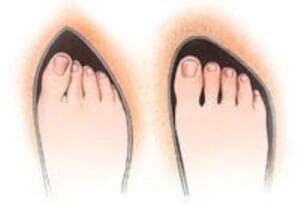
Left) Avoid narrow, pointed shoes that squeeze the toes. (Right) Instead, look for shoes with a roomy toe box.
When to Consider Bunion Surgery
Your doctor may recommend surgery for a bunion or bunionette if, after a period of time, you have pain and difficulty walking despite changes in footwear and other nonsurgical treatments. The goal of bunion surgery is to relieve pain by realigning the bone, ligaments, tendons, and nerves so that the big toe can be brought back to its correct position. You should only consider surgery for a bunion that is painful. There are many surgical options to correct bunions. Generally speaking, smaller surgeries are done for small bunions, and larger procedures are required for severe bunions. Your doctor will recommend a type of bunion surgery for you based on your X-rays and physical exam findings. Bunion surgery is typically performed as a same-day procedure with no hospital stay, but a long recovery is common after bunion surgery. Depending on which type of bunion surgery you have, you may be able to bear weight on the foot using a stiff-soled shoe right after surgery, or you may have a short period of immobilization with no weightbearing. Surgery to remove an adolescent bunion is not recommended unless the bunion causes extreme pain that does not improve with a change in footwear or addition of orthotics. If an adolescent has bunion surgery, particularly before reaching skeletal maturity, there is a strong chance the bunion will return. Reference: Dr. Ziad Harb - orthoinfo.aaos.orgKeep reading