Bunion Surgery
In general, if your bunion is not painful, you do not need surgery.
This article provides information on surgery for bunions. For more general information: Bunions.Most people with bunions find pain relief with simple treatments to reduce pressure on the big toe, such as wearing wider shoes or using pads in their shoes. However, if these measures do not relieve your symptoms, your doctor may recommend bunion surgery.There are different types of surgeries to correct a bunion. Bringing the big toe back to its correct position may involve realigning bone, ligaments, tendons, and nerves.
Are You a Candidate for Surgery?
- Significant foot pain that limits their everyday activities, including walking and wearing reasonable shoes. They may find it hard to walk more than a few blocks (even in athletic shoes) without significant pain.
- Chronic big toe inflammation and swelling that does not improve with rest or medications
- Toe deformity'a drifting in of the big toe toward the smaller toes, creating the potential for the toes to cross over each other.
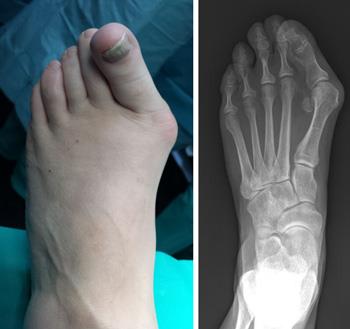
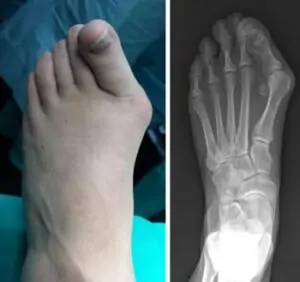
(Left)'A bunion that has progressed to deformity with the big toe crossing over the second toe.'(Right)'An x-ray of the same bunion shows how far out of alignment the bones are.'Reproduced from Wagner E, Ortiz C: Proximal Oblique Sliding Closing-wedge Osteotomy for Wide-angle Hallux Valgus. Orthopaedic Knowledge Online Journal: Vol 12, No 4, 4/1/2014; Accessed December 4, 2015.
- Toe stiffness'the inability to bend and straighten the big toe
- Failure to obtain pain relief with changes in footwear
- Failure to obtain pain relief from nonsteroidal anti-inflammatory drugs (NSAIDs), such as ibuprofen and naproxen. The effectiveness of NSAIDs in controlling toe pain varies greatly from person to person.
Deciding to Have Bunion Surgery
- What are the benefits and risks of this surgery?
- What are the possible complications and how likely are they to occur?
- How much pain will there be and how will it be managed?
Surgical Procedures
- Realigning the metatarsophalangeal (MTP) joint at the base of the big toe
- Relieving pain
- Correcting the deformity of the bones making up the toe and foot
Repairing the Tendons and Ligaments Around the Big Toe
In some cases, the soft tissues around the big toe may be too tight on one side and too loose on the other. This creates an imbalance that causes the big toe to drift toward the other toes. Surgery can shorten the loose tissues and lengthen the tight ones. This is rarely done without some type of alignment of the bone, called an osteotomy. In the majority of cases, soft tissue correction is just one portion of the entire bunion corrective procedure.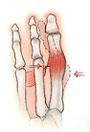
Osteotomy
In an osteotomy, your doctor makes small cuts in the bones to realign the joint. After cutting the bone, your doctor fixes this new break with pins, screws, or plates. The bones are now straighter, and the joint is balanced. Osteotomies may be performed in different places along the bone to correct the deformity. In some cases, in addition to cutting the bone, a small wedge of bone is removed to provide enough correction to straighten the toe. As discussed above, osteotomies are normally performed in combination with soft tissue procedures, as both are often necessary to maintain the big toe alignment.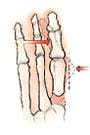
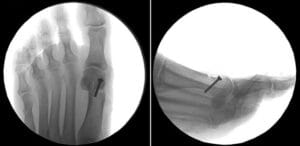
X-rays taken from the top and the side of the foot show a bunion corrected with osteotomy.
Arthrodesis
In this procedure, your doctor removes the arthritic joint surfaces, then inserts screws, wires, or plates to hold the surfaces together until the bones heal. Arthrodesis is commonly used for patients who have severe bunions or severe arthritis, and for patients who have had previous unsuccessful bunion surgery.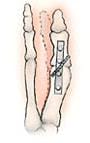
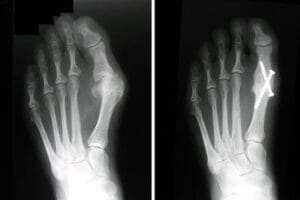
The x-ray on the left shows severe arthritis of the MTP joint. After arthrodesis (shown on the right), the entire foot is realigned. An advantage of arthrodesis is that no additional procedures are necessary to correct the bunion.